Just Released 2/19/23. All of the Sacred Canons of the Holy Orthodox Church (the Holy Apostles, the Seven Ecumenical Councils, the Holy Fathers and additional Councils). VOLUME I OF THE RUDDER CAN BE ORDERED HERE
PREVIEW A PDF SAMPLE:

AVAILABLE AT THE FOLLOWING BOOK RETAILERS:


.
“The Seven Thunders Sounded Their Voices…” – Revelation 10:4
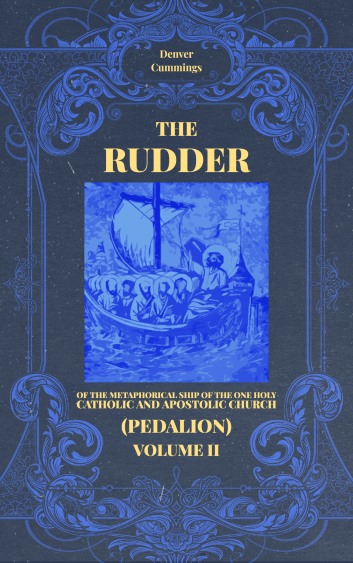
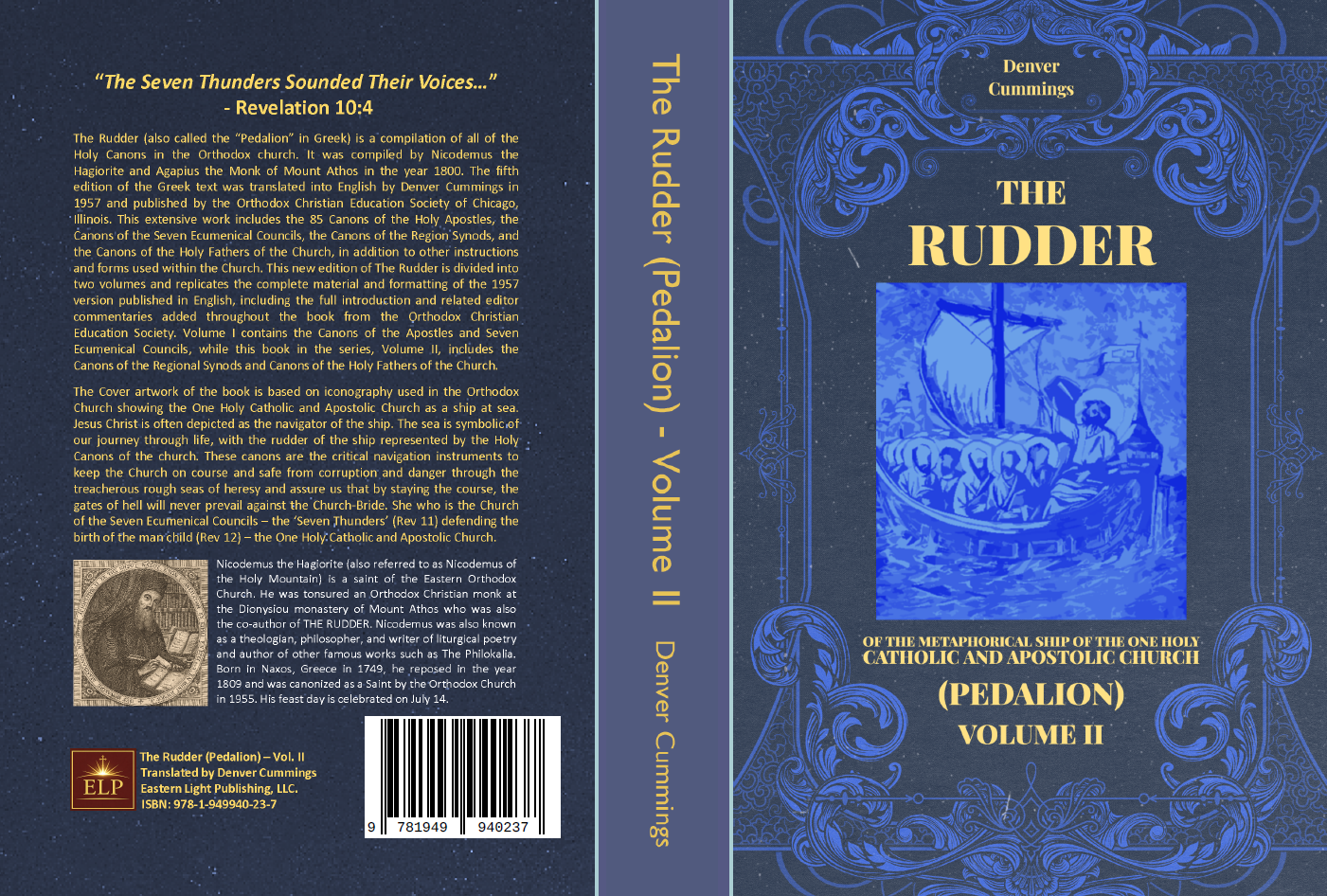
The Rudder (also called the “Pedalion” in Greek) is a compilation of all of the Holy Canons in the Orthodox church. It was compiled by Nicodemus the Hagiorite and Agapius the Monk of Mount Athos in the year 1800. The fifth edition of the Greek text was translated into English by Denver Cummings in 1957 and published by the Orthodox Christian Education Society of Chicago, Illinois. This extensive work includes the 85 Canons of the Holy Apostles, the Canons of the Seven Ecumenical Councils, the Canons of the Region Synods, and the Canons of the Holy Fathers of the Church, in addition to other instructions and forms used within the Church. This new edition of The Rudder is divided into two volumes and replicates the complete material and formatting of the 1957 version published in English, including the full introduction and related editor commentaries added throughout the book from the Orthodox Christian Education Society. Volume I contains the Canons of the Apostles and Seven Ecumenical Councils, while this book in the series, Volume II, includes the Canons of the Regional Synods and Canons of the Holy Fathers of the Church. The Cover artwork of the book is based on iconography used in the Orthodox Church showing the One Holy Catholic and Apostolic Church as a ship at sea. Jesus Christ is often depicted as the navigator of the ship. The sea is symbolic of our journey through life, with the rudder of the ship represented by the Holy Canons of the church. These canons are the critical navigation instruments to keep the Church on course and safe from corruption and danger through the treacherous ‘rough seas’ of heresy and assure us that by staying the course, the gates of Hell will never prevail against the Church-Bride. She who is the Church of the Seven Ecumenical Councils, symbolized as ‘Seven Thunders’ defending the ‘Birth’ of the ‘Man Child’ (Rev 12) – the One Holy Catholic and Apostolic Church.
The Cover artwork of the book is based on iconography used in the Orthodox Church showing the One Holy Catholic and Apostolic Church as a ship at sea. Jesus Christ is often depicted as the navigator of the ship. The sea is symbolic of our journey through life, with the rudder of the ship represented by the Holy Canons of the church. These canons are the critical navigation instruments to keep the Church on course and safe from corruption and danger through the treacherous ‘rough seas’ of heresy and assure us that by staying the course, the gates of Hell will never prevail against the Church-Bride. She is the Church of the Seven Ecumenical Councils, symbolized in the scriptures as Seven Pillars and Seven Thunders (Rev. 10) – the One, Holy, Catholic and Apostolic Church.
Nicodemus the Hagiorite (Nicodemus of the Holy Mountain) is a saint of the Eastern Orthodox Church. He was an Orthodox Christian monk at the Dionysiou monastery of Mount Athos who was also the co-author of THE RUDDER, Nicodemus was also a theologian, philosopher, and writer of liturgical poetry and author of other famous works such as The Philokalia. Born in Naxos, Greece in 1749, he reposed in the year 1809 and was canonized as a Saint by the Orthodox Church in 1955. His feast day is celebrated on July 14.
Editor’s Introduction from ELP
This new release of the 1957 English translation of The Rudder (Pedalion) of the Orthodox Church is presented in two volumes (Vol. I and Vol. II) for the benefit of English-speaking clergy, seminarians, and other serious students of the Orthodox tradition throughout the world. The purpose of this edition is to make accessible one of the most important canonical collections of the Orthodox Church so that it may be used as a resource for studying and understanding the historical canons of the Church.
The Rudder has long served as a guide for clergy who, in cooperation with their bishops, seek to interpret and apply the sacred canons to contemporary pastoral situations. For this reason, the work has traditionally been studied primarily within the context of ecclesiastical life and under proper spiritual guidance. While lay readers may certainly benefit from studying the holy canons, it should be remembered that their interpretation and application properly belong within the life and authority of the Church.
This two-volume edition reproduces nearly all of the content of the 1957 English translation prepared by Denver Cummings and published by the Orthodox Christian Educational Society of Chicago, Illinois. That publishing house, active throughout much of the twentieth century, produced a number of English translations of Greek theological works and made an important contribution to the availability of Orthodox literature in the English-speaking world. This edition therefore seeks, in part, to honor the labor of those editors and translators—such as Kostas Andronis—who worked to produce the first complete English version of this important canonical text. The aim of this edition is not to revise the historic English translation, but to preserve it as faithfully as possible while presenting the text in a clear and transparent form for modern readers.
In recent years, various digital copies of the 1957 edition have circulated online. Some of these reproductions contain significant omissions in which portions of the editorial commentary have been removed or obscured. In certain cases, the removed material has been described as extraneous or potentially problematic. As a result, some versions appear with visibly missing or redacted sections, creating confusion for readers regarding the contents of the original publication.
For the sake of transparency and historical accuracy, the present edition restores most of the original editorial material included in the 1957 translation. It should be noted that these additions were not part of the original Greek text of the Pedalion, nor were they written by the nineteenth-century theologian Apostolos Makrakis, whose name has sometimes been associated with them. Rather, these passages were editorial comments inserted by the translators and editors of the Orthodox Christian Educational Society. Such material was clearly identified in the original edition with designations such as “By the Editors” or “From the Editors.”
Because some readers may prefer to distinguish clearly between the canonical text and the later editorial additions, the restored commentary in this edition has been placed in clearly marked grey boxes. This allows readers to easily recognize the editorial material and to decide for themselves whether to consult it or pass over it while reading the primary text.
By preserving these materials while clearly distinguishing them from the canonical text itself, this edition seeks to present the 1957 translation in a form that is both historically faithful and editorially transparent. In this way, readers are able to encounter the work substantially as it appeared in its original English publication while still easily recognizing the difference between the ancient canons and the later editorial commentary.
Certain sections of the original publication that consisted solely of advertisements for other books issued by the 1957 publisher have been omitted, since this material is no longer relevant to the present edition.
The sacred canons preserved in the Rudder represent the accumulated wisdom of the Orthodox Church as expressed through the Holy Apostles, the Ecumenical Councils, and the Fathers of the Church. Through these canons the Church has safeguarded the purity of the apostolic faith and maintained order within her life across the centuries. They remain an essential guide for the pastoral governance of the Church and for the preservation of her unity and doctrine. Just as a ship requires a rudder to maintain its course upon the sea, so the Church relies upon the guidance of the holy canons to steer safely through the challenges of each age. Without this canonical tradition, the Church would risk drifting amid the moral and doctrinal confusion of the world. With it, she remains firmly anchored in the faith once delivered to the saints.
May the Lord guide all who study these sacred canons, and grant wisdom to those entrusted with shepherding His flock within the One, Holy, Catholic, and Apostolic Church.
– Jonathan Photius, Eastern Light Publishing, LLC Date: 2/19/23
 Eastern Light Publishing, LLC.